Title: Skyward Hazards: The Increasing Threat of Falling Space Junk to Airplanes
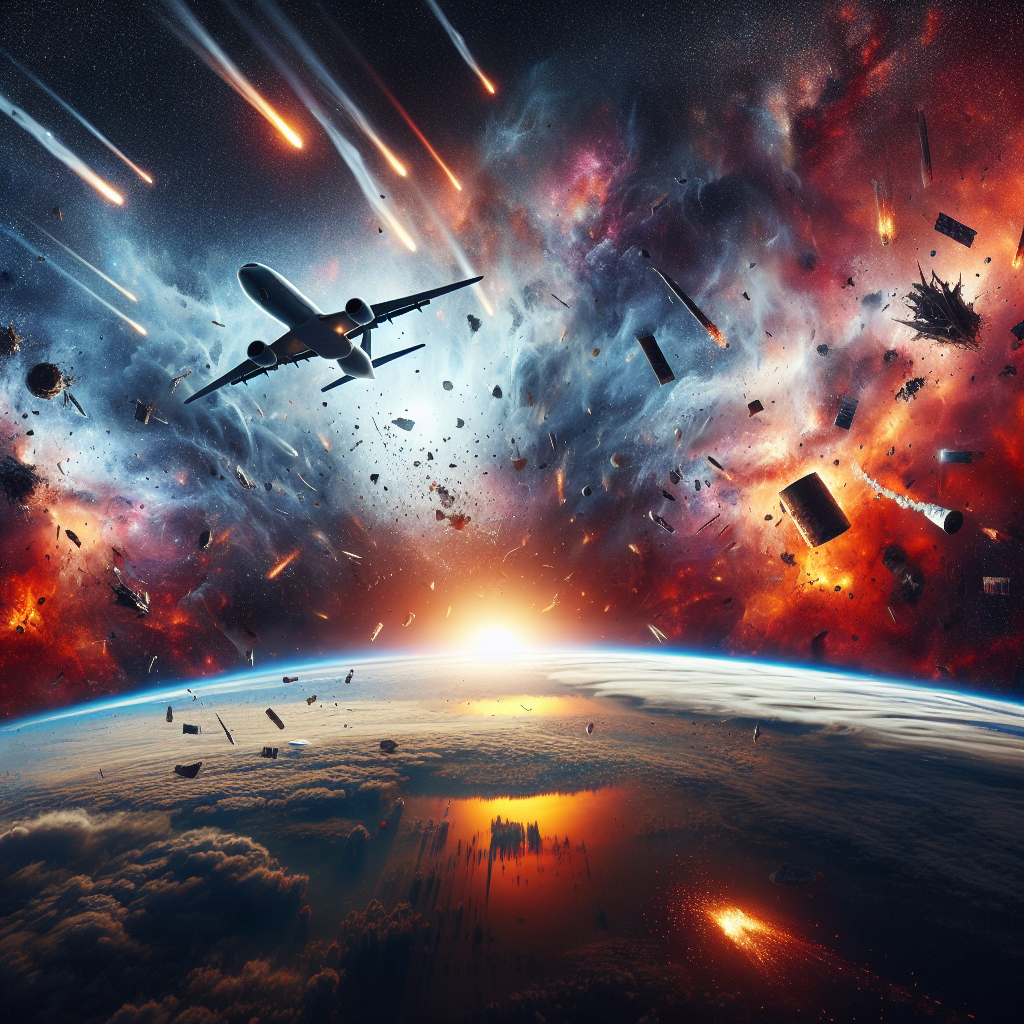
As the cosmos above us becomes increasingly congested with defunct satellites and fragments of spent rocket stages, the risk to our aircraft from falling space debris is escalating, warn leading space experts.
With the advent of the space age during the mid-20th century, the issue of ‘space junk’ has only grown over time. As we’ve launched more satellites and spacecraft into orbit, not all have returned safely, leaving a trail of debris circling our planet. This detritus, once harmless, is now posing a substantial risk to our aviation industry.
The concern is not unwarranted. There are currently more than 23,000 pieces of space debris larger than a softball orbiting Earth, according to NASA’s Orbital Debris Program Office. These fragments, moving at incredible speeds, can wreak havoc if they collide with anything in their path.
While most space junk will burn up upon re-entry into the Earth’s atmosphere, some larger pieces can survive the fiery descent and pose a threat to both people and property on the ground. The odds of such an event affecting an airborne aircraft, though still relatively low, are undoubtedly on the rise.
“Space debris falling to Earth is a growing threat that we need to address,” says Dr. Hugh Lewis, a leading expert in the field of space debris and a senior lecturer in Aerospace Engineering at the University of Southampton. “The risk is still small, but it’s a risk that’s increasing over time.”
The risk factor is compounded by the increasing number of satellites in space. There are approximately 2,800 operational satellites in orbit today, a number that has more than doubled in the past decade. With the surge in the number of satellite launches, especially small and cheap ‘CubeSats,’ the likelihood of creating more space debris has increased.
Efforts are underway to mitigate this growing threat. The international space community is actively developing ways to reduce space junk and improve the long-term sustainability of our space activities. Agencies like NASA and the European Space Agency (ESA) are working on models to predict the movement of space debris and developing technologies to remove it.
For example, the ESA’s ClearSpace-1 mission, set to launch in 2025, aims to capture and de-orbit a part of an old Vega rocket, demonstrating that we can indeed clean up our cosmic backyard.
While the risk of a space debris-aircraft collision is increasing, experts reassure that it remains a rare event. However, the urgency to address the growing problem of space junk is clear. As we continue to utilize space for digital communication, navigation, and exploration, it is imperative that we ensure the safety and sustainability of our cosmic frontier.
For now, though, while you sit back on your next flight, you can gaze out the window at the vast sky, perhaps catching a glimpse of a shooting star – which might just be a piece of space junk burning up in the Earth’s atmosphere.
Read more from the original source here: [Space.com](https://www.space.com/space-exploration/satellites/the-risk-of-falling-space-junk-hitting-airplanes-is-on-the-rise-experts-warn).