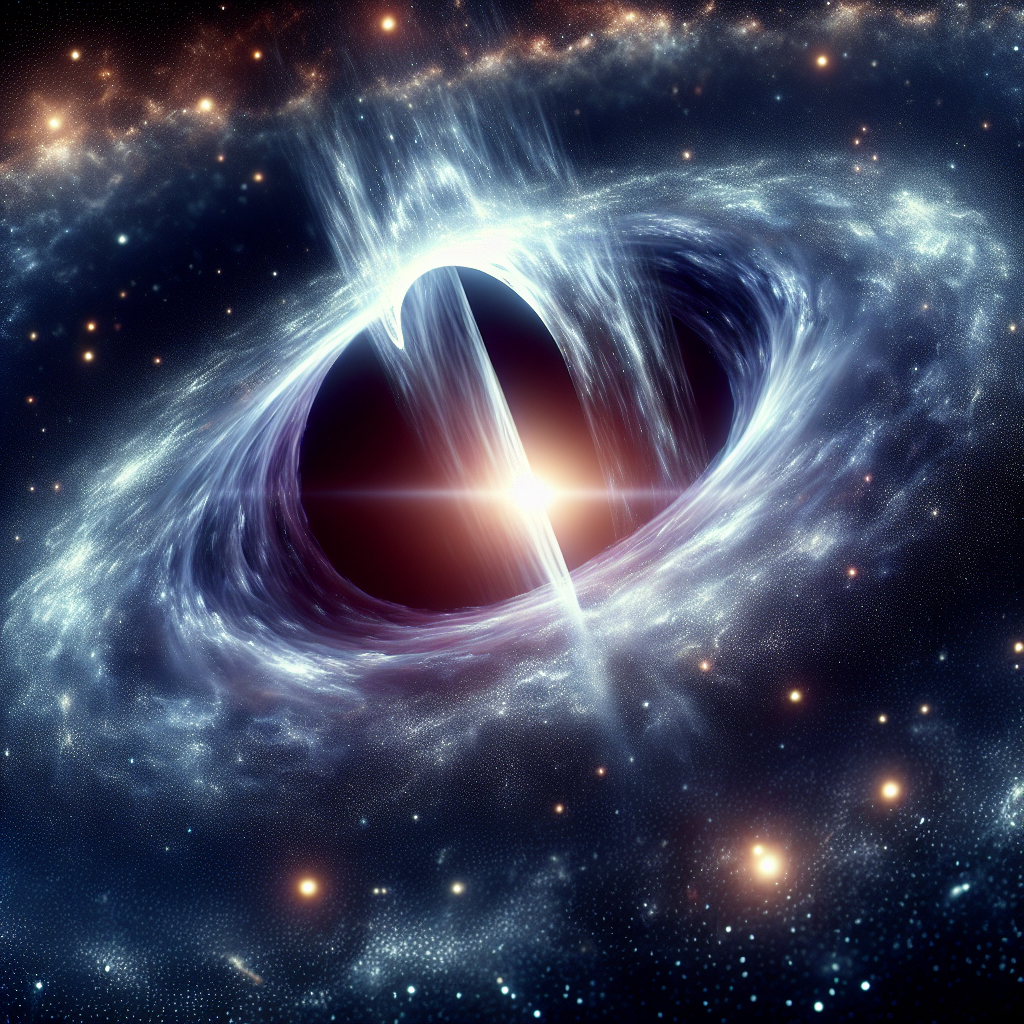
Wormholes, the theoretical cosmic ‘shortcuts’ often beloved by science fiction authors and filmmakers, may not exist at all, according to recent research. But don’t be disappointed. This revelation, far from dampening our excitement about the universe, is set to deepen our understanding of time and the cosmos itself.
Albert Einstein and Nathan Rosen, two renowned physicists, introduced the concept of wormholes in 1935. Popular culture often misinterprets their work as a road map for space travel. However, the real puzzle that Einstein and Rosen were trying to solve had little to do with traversing vast distances of space. Instead, they were interested in something even more profound: understanding how quantum fields behave in curved spacetime.
Quantum fields and curved spacetime might sound like the stuff of science fiction, but they’re very real concepts in the world of physics. Quantum fields are the ‘stuff’ from which all particles, like protons and electrons, emerge. Curved spacetime, on the other hand, is a concept that arises from Einstein’s theory of general relativity, which describes how massive objects like stars and planets bend the fabric of space and time around them.
The question of how quantum fields behave in this bent, or ‘curved’, spacetime is a fundamental one in the search for a theory of quantum gravity. Quantum gravity aims to reconcile general relativity, which describes the universe on a large scale, with quantum mechanics, which explains the behavior of the tiniest particles.
So, where do wormholes come in? In their original work, Einstein and Rosen were using the concept of a wormhole as a tool to study the behavior of quantum fields in curved spacetime. They were not proposing wormholes as actual physical entities or shortcuts through space.
Recent research has suggested that if wormholes do exist, they might be incredibly unstable, essentially snapping shut before anything could pass through them. This has led some scientists to question whether wormholes exist at all.
But whether or not wormholes are real isn’t the point. The real value of the concept lies in what it can teach us about the universe. Studying hypothetical wormholes can lead to insights into the nature of quantum fields and curved spacetime. This could, in turn, provide clues for the elusive theory of quantum gravity.
In other words, while wormholes might not be the cosmic shortcuts we’ve dreamed of, they may hold the key to understanding some of the deepest mysteries of our universe. Einstein and Rosen’s work, therefore, is not a map of the cosmos, but a guide to its underlying principles.
So, let’s not mourn the potential non-existence of wormholes. Instead, let’s celebrate the deeper understanding of time and the universe that their study could bring us.
Read more from the original source here: [https://www.space.com/astronomy/wormholes-may-not-exist-weve-found-they-reveal-something-deeper-about-time-and-the-universe](https://www.space.com/astronomy/wormholes-may-not-exist-weve-found-they-reveal-something-deeper-about-time-and-the-universe).