Space News – July 16, 2025

In an unprecedented astronomical observation, scientists have witnessed the birth of an entirely new star system for the first time in human history. The event, which marks a significant milestone in our understanding of how planets come into existence, centers around the newly formed star HOPS-315.

HOPS-315, an infant star in the early stages of its life cycle, is not alone in its celestial cradle. Astronomers have detected young planets in the process of formation around it, giving us a rare glimpse into the genesis of a planetary system.

Planetary system formation is a complex and drawn-out process that takes millions of years to complete. It begins with a colossal cloud of gas and dust that slowly contracts under the force of gravity. As the cloud shrinks, it spins faster and faster, eventually flattening into a disk. In the center of this whirling maelstrom, a protostar forms, gradually growing in size and heat until it ignites to become a fully-fledged star.

Meanwhile, the remaining material in the disk starts to coalesce into planetesimals – the building blocks of planets. Over time, these planetesimals collide and merge, growing larger and larger until they form fully formed planets.

The birth of the star system around HOPS-315 is a spectacle that is currently unfolding in real-time, allowing scientists a unique opportunity to observe and study this process as it happens.

What makes this event more significant is that such observations are not easy to make. Planetary systems are usually born in dense and turbulent regions of space, where dust and gas obscure our view. Only with the latest advancements in telescope technology are we now able to pierce through this cosmic veil and observe these processes directly.

The discovery and observation of the HOPS-315 system open a new chapter in our understanding of planetary formation. By studying this system, astronomers hope to gain insights into the conditions that lead to the birth of planets, and perhaps, provide clues to the origins of our own Solar System.

The discovery is not just a triumph for astronomers, but also a testament to human curiosity and our unending quest to understand the universe. It serves as a reminder that there is still much to learn about the cosmos, and each new discovery brings us one step closer to unraveling its many mysteries.

The birth of a planetary system is a spectacle of cosmic proportions, and witnessing it for the first time is a landmark event in the annals of human exploration. It is a step towards understanding not just where we came from, but also where we might be headed, as our knowledge of the universe continues to expand.

For those interested in witnessing this astronomical marvel for themselves, a video of the event has been made available. It offers a fascinating glimpse into the birth of a star system, a process that has been taking place across the universe for billions of years, and one that is now, finally, within our sight.

Read more from the original source here: [https://www.space.com/astronomy/astronomers-witness-the-birth-of-a-planetary-system-for-the-1st-time-photo-video](https://www.space.com/astronomy/astronomers-witness-the-birth-of-a-planetary-system-for-the-1st-time-photo-video).

Space News – July 15, 2025

In the realm of space and science fiction, Apple TV+ has confirmed that it will boldly go where it has already been. The streaming giant has officially greenlit a second season of its highly acclaimed series, ‘Murderbot,’ based on Martha Wells’s witty science fiction novels.

The ‘Murderbot’ series, which has captivated audiences with its unique blend of humor, action, and exploration of what it really means to be sentient, has been lauded as an excellent adaptation of Wells’s original works. The titular character, a self-aware security unit dubbed ‘Murderbot,’ has charmed viewers with its relatable struggles with social anxiety and yearning for independence, all against an awe-inspiring backdrop of space exploration and futuristic technology.

The announcement of the second season comes as a thrilling news for the millions of fans who have been eagerly waiting for the next chapter in Murderbot’s journey. The first season ended on a cliffhanger, leaving viewers wondering what’s next for the endearing artificial intelligence.

Apple TV+’s decision to renew ‘Murderbot’ signals a firm commitment to quality science fiction programming, a genre that has proven to be increasingly popular on streaming platforms. The show’s success is undoubtedly a testament to the power of storytelling that combines the limitless possibilities of space with the complex nuances of human (and non-human) experience.

Martha Wells’s novels have garnered a wide following for their ability to inject wit and depth into the science fiction genre, and Apple TV+ has expertly translated these elements to the small screen. The show’s renewal is a testament to the growing appetite for thought-provoking and well-crafted science fiction. The continuation of Murderbot’s story will undoubtedly keep viewers engaged and excited for what’s to come.

The second season of ‘Murderbot’ will continue to explore the expansive universe set out in Wells’s novels. Audiences can expect more breathtaking visuals, heart-stopping action, and of course, the dry humor that has become a hallmark of the series. But above all, viewers will get to delve deeper into the mind of Murderbot, one of the most unique characters in recent science fiction history.

The world of space exploration and science fiction is vast and ever-evolving, and ‘Murderbot’ has carved out its own special niche. As we look to the stars and imagine what lies beyond, we need stories like ‘Murderbot’ to excite our imagination, challenge our perceptions and, of course, keep us entertained.

In a universe filled with infinite possibilities, one thing is clear: ‘Murderbot’ is ready for another mission, and we’re more than ready to join the ride. Here’s to season two, and the continued exploration of the mind, the heart, and the farthest reaches of space.

Read more from the original source here: [https://www.space.com/entertainment/space-movies-shows/boldness-is-all-murderbot-is-getting-a-season-2-on-apple-tv](https://www.space.com/entertainment/space-movies-shows/boldness-is-all-murderbot-is-getting-a-season-2-on-apple-tv).

Master the Sky: DJI’s Motion Controllers Make FPV Drone Flight Accessible to All

Title: Master the Sky: DJI’s Motion Controllers Make FPV Drone Flight Accessible to All

Imagine effortlessly gliding through the sky, twisting and turning, diving and soaring, all with the ease of a single hand movement. This is no longer merely the stuff of dreams, thanks to DJI’s innovative motion controllers that have revolutionized the way we fly FPV (First Person View) drones.

DJI, a world leader in civilian drones and aerial imaging technology, has once again pushed the boundaries of what is possible. The new DJI motion controllers, designed for their high-performance FPV drones, have simplified flight controls to an almost intuitive level. Anyone, regardless of previous drone piloting experience, can now take to the skies and experience the thrill of FPV flight.

Until now, flying an FPV drone required a certain level of expertise. The detailed understanding of complex remote controllers, with their myriad buttons and joysticks, often served as a barrier for newcomers. DJI’s motion controllers, however, have made such hurdles a thing of the past.

The controllers are ingeniously designed to respond to natural hand movements. The pilot can steer the drone in any direction by simply tilting the controller, mimicking the sensation of flying. A single button press controls acceleration, while another handles braking and hovering. This intuitive design makes the learning curve far less steep, allowing even beginners to quickly become competent pilots.

But DJI’s motion controllers are not just about making flying easier. They also open up new possibilities for exploration and creativity. With the ability to fly at speeds of up to 87 mph and a range of over six miles, DJI’s FPV drones can take you on exciting aerial adventures. Furthermore, the drones are equipped with a high-definition camera that provides an immersive, real-time view of your flight, enabling breathtaking cinematography.

As we venture further into the era of space exploration, the importance of drone technology continues to grow. Drones are increasingly being used for a variety of purposes, from scientific research to disaster relief, and even potential planetary exploration. DJI’s innovation in drone control technology is a significant step forward, making drone flight more accessible and potentially paving the way for broader applications of this technology.

In a world where technology often seems to complicate rather than simplify, DJI’s motion controllers are a breath of fresh air. Their design is a testament to the power of innovation, showing that with a little imagination, barriers can be transformed into gateways. So whether you’re an experienced pilot looking for a new challenge, or a novice eager to take your first flight, DJI’s motion controllers offer an exciting new way to explore the sky.

Read more from the original source here: [Fly DJI FPV drones like a pro with DJI’s motion controllers](https://www.space.com/technology/drones/fly-dji-fpv-drones-like-a-pro-with-djis-motion-controllers).

Private Ax-4 Astronauts Set to Return Back to Earth on July 14

Title: Private Ax-4 Astronauts Set to Return Back to Earth on July 14

The stars have aligned for the private Ax-4 astronaut mission, as they prepare to undock from the International Space Station and make their journey back to Earth early on July 14. This historic event will be broadcast live, allowing viewers worldwide to share in the excitement and anticipation.

The Ax-4 mission, the first of its kind, has paved the way for the future of private space travel. Since docking at the International Space Station, the crew has carried out a series of scientific experiments, demonstrating the viability of private astronauts contributing to the ongoing exploration of space.

As the astronauts bid farewell to their temporary home in the cosmos, they do so with a wealth of new knowledge and an inspiring vision of what the future of space exploration could hold. The trip back home, while marking the end of their mission, symbolizes the beginning of a new era in space travel where private astronauts can contribute to the scientific understanding of space.

The undocking procedure is a carefully choreographed event, with safety as the utmost priority. The spacecraft will slowly pull away from the International Space Station, a move that requires pinpoint precision. Once the spacecraft is a safe distance away, it will fire its engines for the deorbit burn, a maneuver that will direct the craft back towards Earth.

The return journey is not without its challenges. The spacecraft must survive the fiery re-entry into Earth’s atmosphere, a phase known as the “seven minutes of terror” due to the extreme heat and pressure. However, with the advanced technology onboard the spacecraft, coupled with the extensive training and preparedness of the crew, the astronauts are set to overcome these hurdles.

The live broadcast of the undocking will offer viewers a unique opportunity to witness this monumental event in real-time. It is not just about the thrill of the spectacle, but also about the shared human experience of exploration and discovery.

The Ax-4 mission is a testament to the progress we have made in space exploration. It signifies the dawn of a new era, where space travel is no longer the exclusive domain of government agencies. It has demonstrated that with the right technology, training, and determination, private astronauts can venture into space and contribute to our understanding of the universe.

As we await the return of the Ax-4 astronauts, we are reminded of the immense potential that lies within each of us to explore, innovate, and push beyond the boundaries of what is known. The stars, as they say, are the limit.

Watch the live broadcast of the Ax-4 astronauts’ journey back to Earth on July 14 and be a part of this historic moment in space exploration.

Read more from the original source here: [https://www.space.com/space-exploration/private-spaceflight/private-ax-4-astronauts-heading-back-to-earth-early-july-14-watch-it-live](https://www.space.com/space-exploration/private-spaceflight/private-ax-4-astronauts-heading-back-to-earth-early-july-14-watch-it-live).

‘Survivor: NASA’ — A Glimpse Into the Latest Episode of ‘This Week In Space’ Podcast

Title: ‘Survivor: NASA’ — A Glimpse Into the Latest Episode of ‘This Week In Space’ Podcast

The galaxy of space exploration news is vast, and for those seeking to stay informed, ‘This Week In Space’ podcast hosted by Rod Pyle and Tariq Malik provides the perfect guide. In the recently released episode 168, titled ‘Survivor: NASA’, the hosts delve into the latest headlines and developments from NASA, the world’s leading space agency.

The episode’s title, ‘Survivor: NASA’, might spark thoughts of reality TV-style competitions among astronauts. However, it instead refers to the resilience and adaptive nature of the space agency amidst changing leadership and evolving space exploration objectives.

One of the key takeaways from the episode is the appointment of Sean Duffy as the Interim NASA Administrator. Duffy’s appointment comes at a critical time for NASA as the agency continues working on projects like the Artemis program, aiming to return humans to the Moon by 2024.

Duffy, who previously served in various roles within NASA, is expected to guide the agency during this transition period. The hosts discuss the implications of his appointment in detail, offering insights into what it could mean for the future of NASA and space exploration.

But ‘Survivor: NASA’ isn’t just about administrative changes. Pyle and Malik also dive into other fascinating topics, from updates on Mars rovers to the latest on space tourism. They explore the scientific and technological advancements that are propelling us closer to understanding our universe.

The podcast episode serves as a testament to the enduring spirit of space exploration. Despite setbacks, changes, and challenges, NASA continues to forge ahead in its quest to unravel the mysteries of the cosmos.

This Week In Space provides listeners with a front-row seat to these developments. The hosts’ engaging discussions, coupled with expert insights, make the complex world of space exploration accessible to all. Whether you’re a space enthusiast or a casual listener, Episode 168, ‘Survivor: NASA’, is sure to captivate your interest with its in-depth look into the happenings at NASA.

As we look up at the night sky and marvel at the stars, it’s easy to forget the intricate work happening behind the scenes to understand our universe. This episode serves as a reminder of the hard work, resilience, and adaptability required to push the boundaries of our knowledge.

So, if you’re curious about the latest in space exploration or want to understand more about NASA’s current trajectory, make sure to tune into ‘Survivor: NASA’ on the This Week In Space podcast. It’s a journey through the cosmos that you won’t want to miss.

Read more from the original source here: [https://www.space.com/entertainment/space-movies-shows/this-week-in-space-podcast-episode-168-survivor-nasa](https://www.space.com/entertainment/space-movies-shows/this-week-in-space-podcast-episode-168-survivor-nasa).

Stellar Savings: Sony A7R V Mirrorless Camera Plummets by $1000 in Anti-Prime Day Deal

Title: Stellar Savings: Sony A7R V Mirrorless Camera Plummets by $1000 in Anti-Prime Day Deal

For all the stargazers and space enthusiasts, here’s a piece of news that’s sure to light up your cosmos. An astonishing deal on the Sony A7R V mirrorless camera has just landed, and it’s a save-the-date moment for all those seeking to capture the universe’s grandeur. A staggering $1000 off the retail price, this deal eclipses even Amazon’s Prime Day prices.

Walmart, the multinational retail corporation, is currently offering the Sony A7R V for a mere $3200, a significant markdown from its usual price tag. This is a rare opportunity to get your hands on one of the most sought-after mirrorless cameras in the market for a fraction of its cost.

The Sony A7R V is a gem in the world of photography, equipped with state-of-the-art features that make it an ideal device for capturing the pristine beauty and boundless mysteries of the cosmos. With a 61-megapixel full-frame sensor, the camera offers unrivaled detail and clarity. Its incredible low-light performance capabilities make it a perfect tool for astrophotography, allowing users to bring out the distant stars and galaxies’ details with remarkable precision.

Furthermore, the Sony A7R V boasts a high-speed continuous shooting capability, up to 10 frames per second, ensuring you never miss out on a meteor shower or a quick passing satellite. Its robust image stabilization ensures sharp, blur-free images even when tracking celestial bodies’ movement across the sky.

The camera’s versatility extends beyond the night sky, making it an excellent choice for capturing all of life’s moments, from family gatherings to wildlife photography. Its weather-sealed design ensures durability and the ability to withstand extreme conditions, whether you’re shooting under the scorching sun or in the freezing cold.

This Sony A7R V deal is part of Walmart’s Anti-Prime Day sale, a savvy response to Amazon’s annual sales event. With such a noteworthy discount on this high-end camera, even the most budget-conscious consumers can now consider adding this powerful tool to their skywatching kit.

For those with a passion for stargazing, astrophotography, or simply capturing the world in stunning detail, the Sony A7R V is an investment that promises to deliver impressive results. This unprecedented discount is a golden opportunity to turn your space exploration dreams into a reality.

The universe and its celestial wonders are waiting to be discovered. Don’t miss out on this chance to bring home the Sony A7R V at a significantly reduced price. Head over to Walmart and take a huge leap towards enhancing your space exploration journey.

Read more from the original source here: [https://www.space.com/stargazing/skywatching-kit/i-couldnt-keep-quiet-about-usd1000-off-the-sony-a7r-v-in-this-anti-prime-day-deal](https://www.space.com/stargazing/skywatching-kit/i-couldnt-keep-quiet-about-usd1000-off-the-sony-a7r-v-in-this-anti-prime-day-deal).

Asteroid 2024 YR4: No Earth Impact, But a Potential Lunar Threat

Title: Asteroid 2024 YR4: No Earth Impact, But a Potential Lunar Threat

Our beloved blue planet, Earth, can breathe easy regarding asteroid 2024 YR4; it’s not on a collision course with us. However, the moon, our celestial neighbor and Earth’s only natural satellite, might not be so lucky. The potential lunar impact presents unanticipated risks to space technology and astronauts alike.

The asteroid in question, 2024 YR4, is a near-Earth object that’s been on the radar of astronomers and space enthusiasts. While it won’t be putting Earth in its crosshairs, it could still rain on our parade, quite literally, by potentially striking the moon. The prospect of such an occurrence might seem thrilling to some, but the repercussions could be far from entertaining.

Space exploration has made remarkable strides in the past decade, and the moon plays an integral role in this journey. From serving as a launch pad for further space exploration to housing potential human colonies, the moon is a significant piece of our cosmic puzzle. A lunar asteroid impact could jeopardize these aspirations and the existing space technology.

The moon is not just a lifeless rock orbiting the Earth; it is a hub for various scientific experiments and technological installations. A lunar impact by an asteroid of substantial size could damage these installations, causing significant setbacks to space missions and scientific research. More immediate and concerning is the potential threat to the astronauts aboard the International Space Station (ISS) or those on future lunar missions. The shockwaves and debris caused by such an impact could pose risks to their safety.

While the potential of asteroid 2024 YR4 impacting the moon might sound alarming, it’s important to remember that space agencies across the globe are in a constant state of vigilance against such threats. NASA’s Planetary Defense Coordination Office, for instance, is dedicated to detecting, tracking, and characterizing potential hazardous asteroids and comets that could impact the Earth. But now, it seems, they may have to broaden their scope to include the moon as well.

The potential impact of 2024 YR4 on the moon serves as a reminder of the unpredictable nature of space and the importance of being prepared for all possible scenarios. In the grand scheme of space exploration, challenges like these are stepping stones towards the development of more robust safety measures and, ultimately, a stronger understanding of our universe.

While no one wants their day, or space mission, ruined by a rogue asteroid, this potential event underscores the need for continual vigilance in our journey through the cosmos. So, as you gaze at the moon tonight, remember, it’s not just a pretty face in the night sky; it’s an integral part of our journey into the unknown.

Read more from the original source here: [https://www.space.com/astronomy/asteroids/asteroid-2024-yr4-wont-earth-but-it-could-still-ruin-your-day-heres-how](https://www.space.com/astronomy/asteroids/asteroid-2024-yr4-wont-earth-but-it-could-still-ruin-your-day-heres-how).

Iconic Star Wars Starship Lands on Amazon Prime Day with a 20% Discount

Title: Iconic Star Wars Starship Lands on Amazon Prime Day with a 20% Discount

For fans of intergalactic journeys and star-studded adventures, today’s Amazon Prime Day brings an exciting opportunity. The Lego Star Wars Millennium Falcon set, a faithful miniature replica of the most iconic starship in the Star Wars universe, is docking on the e-commerce platform with a 20% discount. But be warned, you’ll have to make the Kessel Run in less than twelve parsecs to grab one, as this offer is only available for today.

First piloted by the charismatic Han Solo and his Wookiee co-pilot Chewbacca in the Star Wars universe, the Millennium Falcon has evoked awe and admiration from fans worldwide. This Lego set is a tribute to the starship that made a name for itself by completing the Kessel Run, a dangerous and daring path through the galaxy, in less than twelve parsecs – a feat thought to be impossible.

The Lego Star Wars Millennium Falcon set doesn’t merely mimic the exterior of the legendary spacecraft; it embodies the spirit of the starship. With intricate details, it faithfully represents the Falcon’s complex design that includes the unique circular main body, the cockpit protruding from the side, and the quad laser cannons.

For fans, this Lego set isn’t just a toy, but a piece of the Star Wars saga they can hold in their hands. Assembling the Millennium Falcon provides a hands-on experience of piecing together a piece of galactic history. It engages both the mind and the imagination, transporting Star Wars aficionados to a galaxy far, far away.

But this adventure isn’t just for the Star Wars enthusiasts. This Lego set serves as a gateway for newcomers to the franchise, sparking interest in the expansive Star Wars universe. Moreover, it’s a testament to the power of human creativity and technological advancement, echoing the real-world progress in space exploration and our unending quest to unravel the mysteries of the cosmos.

The Lego Star Wars Millennium Falcon set, with its discounted price, is a golden opportunity for fans and space explorers to own a piece of the Star Wars legacy. However, it’s also a fleeting chance, as the offer is only available today, on Amazon Prime Day.

Whether you’re a lifelong Star Wars devotee or a curious newcomer, a science enthusiast or a Lego lover, the journey to a galaxy far, far away is only a click away. Remember, in the words of the great Star Wars Jedi Master, Yoda, “Do. Or do not. There is no try.” The race is on to grab this iconic starship before it blasts off into the cosmic realms of the sold-out universe.

Read more from the original source here: [https://www.space.com/technology/today-is-your-last-chance-to-save-20-percent-on-the-most-iconic-starship-in-the-star-wars-universe-this-amazon-prime-day](https://www.space.com/technology/today-is-your-last-chance-to-save-20-percent-on-the-most-iconic-starship-in-the-star-wars-universe-this-amazon-prime-day).

Stellar Duo Captured in All Their Glory by Hubble Telescope

Title: Stellar Duo Captured in All Their Glory by Hubble Telescope

In a breathtaking cosmic performance, the NASA/ESA Hubble Space Telescope has captured the bright variable star, V 372 Orionis, and its lesser-known companion star in a single frame. Both celestial bodies reside in the Orion Nebula, a gigantic region of star formation located approximately 1450 light years away from Earth.

The star V 372 Orionis, the more prominent of the two, takes center stage in this recently released image. Known as a variable star, its brightness fluctuates over time due to changes in size and temperature. The smaller companion star, though more modest in appearance, is no less significant. It sits in the upper left of the image, a testament to the vast diversity of celestial bodies that populate the Orion Nebula.

The Orion Nebula, where this stellar duo resides, is one of the most studied and photographed objects in space. Referred to as a star nursery, this nebula is a vast cloud of gas and dust where new stars are born. The nebula’s proximity to Earth, coupled with its active star formation, makes it an ideal laboratory for astronomers seeking to understand the life cycle of stars.

The new image was captured as part of an ongoing mission using the Hubble Space Telescope, a joint venture between NASA and the European Space Agency (ESA). Since its launch in 1990, Hubble has fundamentally changed our understanding of the universe. Its high-resolution images have revealed new galaxies, provided evidence of dark matter, and even helped measure the rate at which the universe is expanding.

The Hubble Space Telescope’s unique vantage point, high above the distortion of Earth’s atmosphere, allows it to capture images with clarity and detail that ground-based telescopes can’t match. This latest image of the stellar duo is a perfect example of this capability.

The captured image of V 372 Orionis and its companion star not only offers a visual feast for space enthusiasts but also provides valuable data to scientists. By studying these stars, researchers can gain insights into the processes that govern star birth, life, and death. This, in turn, may help us comprehend the broader workings of our universe.

As our exploration of the cosmos continues, each new image captured by the Hubble Space Telescope brings us one step closer to understanding our place in the universe. The image of the stellar duo, V 372 Orionis and its companion star, is more than just a beautiful snapshot of the cosmos. It’s a reminder of the vastness of space and the endless possibilities for discovery that lie within it.

Read more from the original source here: [https://www.nasa.gov/image-detail/tempestuous-young-stars-in-orion/](https://www.nasa.gov/image-detail/tempestuous-young-stars-in-orion/)

The Ultimate Martian Adventure: 8 Amazing Places to Visit on Mars

by Rida Fatima

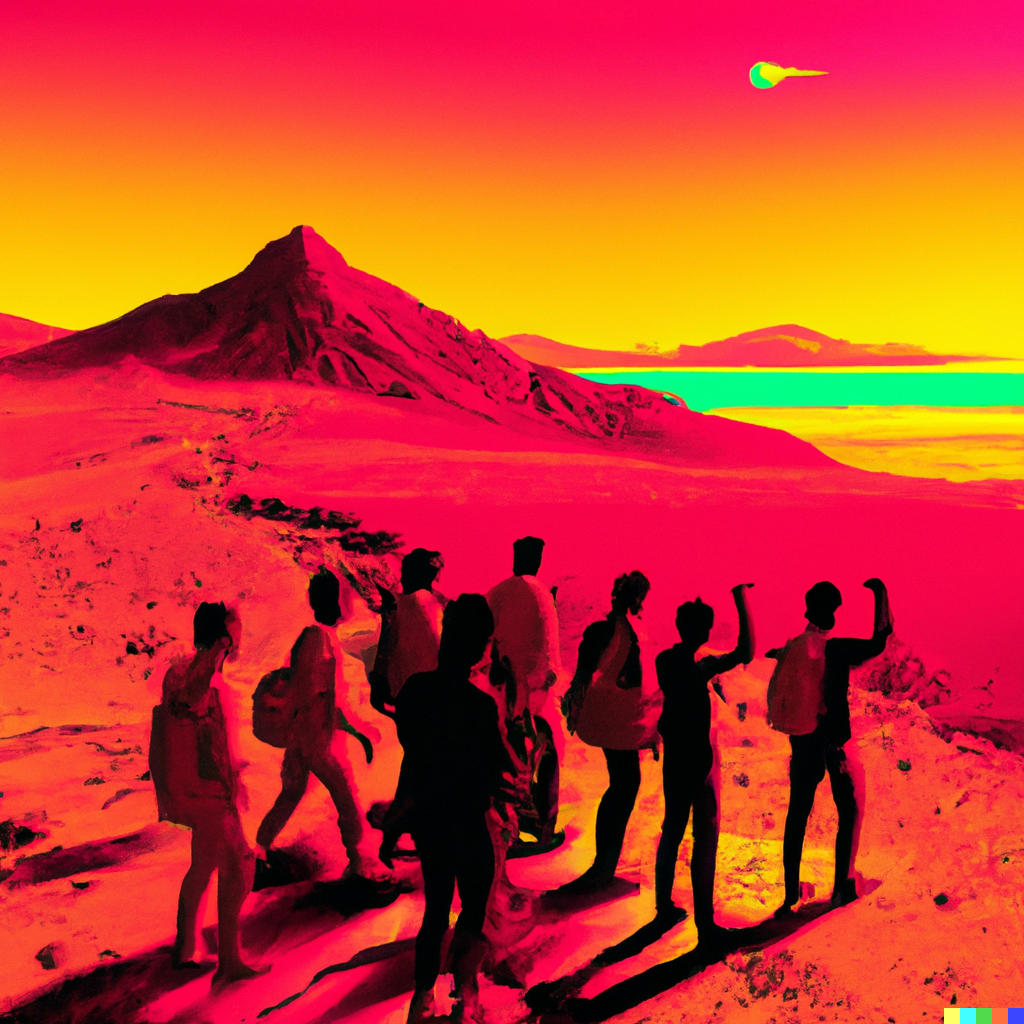
Tourists on Mars
(Image Credit: Dall-e)

Mars, our neighboring planet, has long captivated the imagination of scientists, space enthusiasts, and even the general public. With its stark beauty and vast, barren landscapes, it’s a world of contrasts that fascinates and intrigues us. Imagine standing on the edge of a massive volcano or gazing into the depths of a canyon that dwarfs even the Grand Canyon on Earth. Picture yourself exploring the craters and valleys, searching for signs of life or evidence of ancient civilizations. For future tourists, the possibilities are endless, and the adventure is just beginning. While the landing sites for these missions will likely be chosen for safety and practicality, there’s no shortage of interesting geology to explore. Here are just a few of the incredible locations that await the intrepid travelers of the future.

Olympus Mons

Olympus Mons is one of the most fascinating destinations on Mars, and it’s a must-visit for any future Martian tourist. This massive shield volcano towers over the surrounding landscape, rising to a height of 22 kilometers (13.6 miles) above the Martian surface. To put that in perspective, Olympus Mons is nearly three times the height of Mount Everest, the tallest mountain on Earth! The volcano is so massive that its base is over 550 kilometers (340 miles) wide, making it wider than the entire state of Arizona. Standing on the slopes of Olympus Mons, you’ll feel like you’re on top of the world – or at least, on top of a very large mountain! Whether you’re a geology enthusiast or just looking for an awe-inspiring adventure, Olympus Mons is a destination you won’t want to miss.

Tharsis Volcanoes

Tharsis is a volcanic plateau on Mars that’s home to some of the largest and most impressive volcanoes in the solar system. The Tharsis volcanoes are a must-visit destination for any intrepid Martian traveler, offering breathtaking views and fascinating insights into the geology of this amazing planet. The largest volcano on Tharsis is called Arsia Mons, which stands a towering 16 kilometers (10 miles) high. That’s nearly twice the height of Mount Everest! Another fascinating Tharsis volcano is Pavonis Mons, which is surrounded by a mysterious hexagonal pattern that has puzzled scientists for decades. And then there’s Ascraeus Mons, which is home to a gigantic fissure system that stretches for over 1,000 kilometers (620 miles). Whether you’re a geology enthusiast or just looking for an adventure, the Tharsis volcanoes are a destination you won’t want to miss.

Valles Marineris

Valles Marineris is one of the most breathtaking and awe-inspiring destinations on Mars. This massive canyon system is over 4,000 kilometers (2,500 miles) long and up to 7 kilometers (4.3 miles) deep, making it the largest canyon in the solar system. To put that in perspective, Valles Marineris is ten times longer and five times deeper than the Grand Canyon on Earth! But the canyon is not just big – it’s also home to some fascinating geological features. One of the most interesting is the massive cliff known as the “Great Tharsis Ridge,” which is over 7 kilometers (4.3 miles) high and runs for hundreds of kilometers along the eastern edge of the canyon. And if you’re a fan of extreme sports, Valles Marineris offers some truly out-of-this-world experiences – imagine rappelling down the side of a 7-kilometer-deep canyon, or hiking across a Martian landscape that looks like it belongs on another planet entirely! So if you’re looking for adventure, excitement, and some of the most stunning natural scenery in the solar system, Valles Marineris is the destination for you.

The North And South Poles Of Mars

The poles of Mars are some of the most fascinating and unique destinations in the solar system. Unlike the Earth’s poles, which are covered in ice, the poles of Mars are covered in a mixture of ice and frozen carbon dioxide, known as dry ice. This creates a stunning landscape of white and blue, with towering ice cliffs and deep valleys. One of the most fascinating features of the Martian poles is the seasonal changes – in the winter, the poles are shrouded in darkness and extreme cold, while in the summer, they are bathed in sunlight and relatively warm temperatures. The polar regions of Mars are also home to some fascinating geological features, including massive canyons and valleys, as well as the largest volcano in the solar system – Olympus Mons, which is located near the northern pole. And if you’re lucky, you may even catch a glimpse of the stunning auroras that light up the Martian sky.

The Gale Crater and Mount Sharp (Aeolis Mons)

The Gale Crater and Mount Sharp, also known as Aeolis Mons, are two of the most fascinating and scientifically important destinations on Mars. The Gale Crater is a massive impact crater that’s over 150 kilometers (93 miles) in diameter, and it’s home to the Curiosity rover – one of the most advanced robotic explorers ever sent to Mars. Mount Sharp, located at the center of the Gale Crater, is a towering mountain that rises over 5 kilometers (3 miles) above the surrounding landscape. But Mount Sharp is more than just a mountain – it’s a geological time capsule, with layers of sediment that have been laid down over billions of years. By studying these layers, scientists hope to unlock the secrets of Mars’ past, and learn more about the planet’s geology and history. And if you’re looking for adventure, the Gale Crater and Mount Sharp offer plenty of opportunities for exploration and discovery. From hiking across the Martian landscape to studying the rocks and sediments up close, there’s something for everyone on this incredible planet.

The Recurring Slope Lineae in Hale Crater

The Recurring Slope Lineae (RSL) in Hale Crater are some of the most mysterious and intriguing features on Mars. These dark streaks, which appear to flow down the sides of the crater walls during the Martian spring and summer, have puzzled scientists for years. Some believe that they may be evidence of liquid water on Mars, while others think that they may be caused by dry, flowing sand or dust. Whatever their cause, the RSL in Hale Crater offer a tantalizing glimpse into the geological and environmental mysteries of Mars. And if you’re looking for adventure, exploring the RSL in Hale Crater offers a unique and thrilling experience – imagine rappelling down the side of a Martian crater wall, or hiking through the rugged terrain in search of these elusive features.

Ghost Dunes

The ‘Ghost Dunes’ in Noctis Labyrinthus and Hellas basin are some of the most fascinating and enigmatic features on Mars. These dunes, which are believed to be millions of years old, have been preserved as ghostly outlines in the Martian rock. They were likely formed when Mars had a thicker atmosphere and more abundant liquid water, and they offer a glimpse into the planet’s past climate and geology. The dunes are also a reminder of the incredible power of wind on Mars, which is capable of shaping the landscape in ways that are both beautiful and mysterious. And if you’re looking for adventure, exploring the ‘Ghost Dunes’ offers a unique and thrilling experience – imagine hiking through the rugged terrain in search of these ancient formations, or camping under the Martian sky as you marvel at the wonders of the Red Planet.

Conclusion

Exploring the wonders of Mars is an adventure like no other. From towering mountains and vast canyons to mysterious dunes and ghostly outlines of ancient features, the Red Planet is a treasure trove of geological and environmental marvels. Whether you’re a seasoned explorer or a curious traveler, there’s something for everyone on this incredible planet. So pack your bags, grab your spacesuit, and get ready to experience the wonders of Mars. Who knows what discoveries and adventures await us in the future as we continue to explore and unlock the secrets of this fascinating planet!