
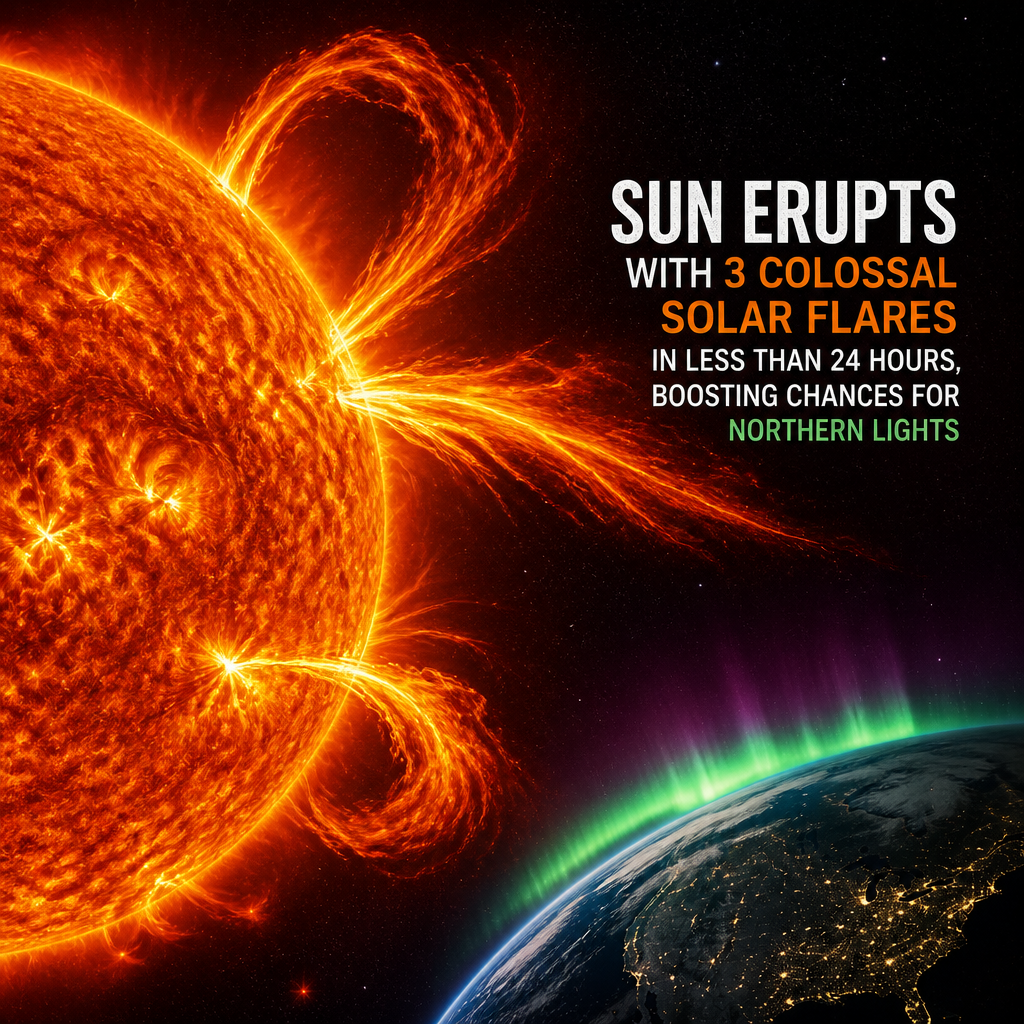
Title: Sun Unleashes Triple Solar Flares, Increases Odds for Northern Lights Show
In an exciting celestial spectacle, three colossal solar flares burst from the Sun in less than 24 hours, causing radio blackouts across Earth and potentially setting the stage for a dazzling display of the northern lights.
Solar flares are explosive outbursts of energy that occur on the surface of the Sun, ejecting massive amounts of solar particles into space. These particles can interact with Earth’s magnetic field, causing disruptions in communication and power systems and, on the brighter side, triggering the radiant phenomenon known as the auroras or northern lights.
The three solar flares, detected by NASA’s Solar Dynamics Observatory, were classified as X-class, the most powerful category of solar flares. This trio of solar eruptions marks one of the most active periods of solar activity in recent years, raising eyebrows and piquing the interest of scientists and space enthusiasts alike.
These solar flares have already had tangible effects on Earth, triggering brief radio blackouts due to the rush of solar particles interfering with our planet’s magnetic field. However, the more enchanting consequence of these gargantuan solar outbursts is the heightened possibility of viewing the northern lights.
The northern lights, or auroras, are a mesmerizing natural light display predominantly seen in high-latitude regions around the Arctic and Antarctic. They occur when solar particles collide with gases in Earth’s atmosphere, causing them to glow. The recent surge in solar activity could supercharge these lights, making them visible even at lower latitudes.
While the radio disruptions caused by solar flares can be problematic, the potential for an enhanced display of the northern lights offers a silver lining. Depending on the trajectory of the solar storms, people residing at higher latitudes may expect a spectacular light show in the coming days.
However, predicting exactly when and where the northern lights will appear can be tricky. Factors such as the speed and direction of the solar winds, the time of night, and local weather conditions can all influence visibility. Those hoping to catch a glimpse of the auroras are advised to stay tuned to the National Oceanic and Atmospheric Administration’s (NOAA) Space Weather Prediction Center forecasts.
This recent burst of solar activity serves as a reminder of the Sun’s powerful and dynamic nature. As our closest star, the Sun’s behavior significantly impacts life on Earth, from the functioning of our technology to the beauty of our night skies. It’s a humbling reminder of our connection to the cosmos and a reason to look up and marvel at the wonders of space.
For those interested in stargazing, the upcoming days may offer a unique opportunity. As we wait to see the potential light show, let’s keep our eyes on the skies and our fingers crossed for clear weather.
Read more from the original source here: [https://www.space.com/stargazing/auroras/sun-erupts-with-3-colossal-solar-flares-in-less-than-24-hours-boosting-chances-for-northern-lights](https://www.space.com/stargazing/auroras/sun-erupts-with-3-colossal-solar-flares-in-less-than-24-hours-boosting-chances-for-northern-lights).