
Title: A Galactic Tug of War: Large Magellanic Cloud is Pulling its Smaller Companion Apart
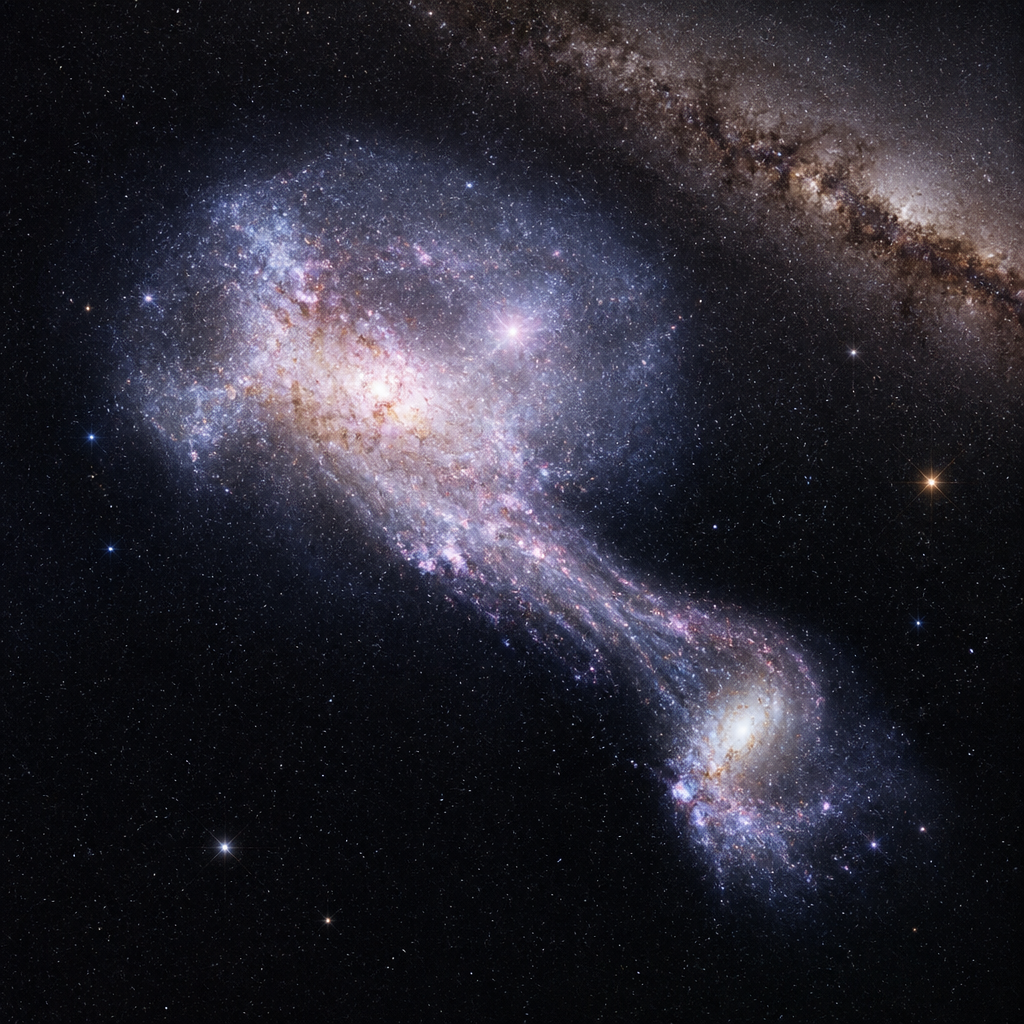
In a grand cosmic ballet that has been unfolding for billions of years, the Large Magellanic Cloud (LMC), a dwarf galaxy, is gradually tearing apart its smaller neighbor, the Small Magellanic Cloud (SMC). This celestial drama is taking place in our galactic neighborhood, as both galaxies are currently passing by the Milky Way, possibly for the first time.
The Magellanic Clouds, named after the explorer Ferdinand Magellan who observed them during his 16th-century circumnavigation of the globe, have been engaged in an intricate celestial dance for billions of years. As they pirouette through the universe, their mutual gravitational forces have been causing a cosmic tug of war, with the larger LMC slowly ripping apart its smaller counterpart, the SMC.
This ongoing interaction between the two dwarf galaxies was observed by a team of international astronomers who have been studying the duo’s trajectory and gravitational effects on each other. Their findings help shed light on the dynamic nature of galaxies and the larger universe, offering us a front-row seat to the spectacular, albeit violent, ballet of the cosmos.
The LMC and SMC are considered dwarf galaxies as they are significantly smaller than spiral galaxies like our Milky Way. Despite their size, these dwarf galaxies exert immense gravitational forces, which are the driving forces behind their continuous interaction. The larger LMC, with its stronger gravitational pull, has been slowly pulling material away from the SMC, essentially tearing it apart over billions of years.
However, this intergalactic tug of war is not a one-sided affair. The SMC, despite being smaller, is also pulling gas and other material from the LMC. The material pulled from both galaxies forms a spectacular bridge of gas, known as the Magellanic Bridge, which stretches over 75,000 light-years between the two galaxies.
This celestial phenomenon provides a fascinating glimpse into the immense forces at work in our universe. It underscores the dynamic and ever-changing nature of galaxies, even those that might seem peaceful and static from our vantage point here on Earth.
Moreover, understanding the interaction between the Magellanic Clouds can provide valuable insights into the future of our own galaxy. The Milky Way is expected to collide with the Andromeda galaxy in about four billion years. By observing how the Magellanic Clouds interact, astronomers can gain a better understanding of what might happen when our galaxy eventually meets its larger neighbor.
In the grand scheme of the universe, galaxies are not static entities but are constantly moving, interacting, and evolving. The ongoing drama between the LMC and SMC serves as a vivid reminder of the dynamic nature of our cosmos, a celestial ballet that has been unfolding for billions of years and that continues to captivate us with its beauty, complexity, and violence.
Read more from the original source here: [Trouble near the Milky Way: The Large Magellanic Cloud is ripping its smaller neighbor galaxy apart](https://www.space.com/astronomy/galaxies/trouble-near-the-milky-way-the-large-magellanic-cloud-is-ripping-its-smaller-neighbor-galaxy-apart).