Title: Galactic Detective: NASA’s X-ray Spacecraft Uncovers Supernova Remains in the Milky Way’s Heart
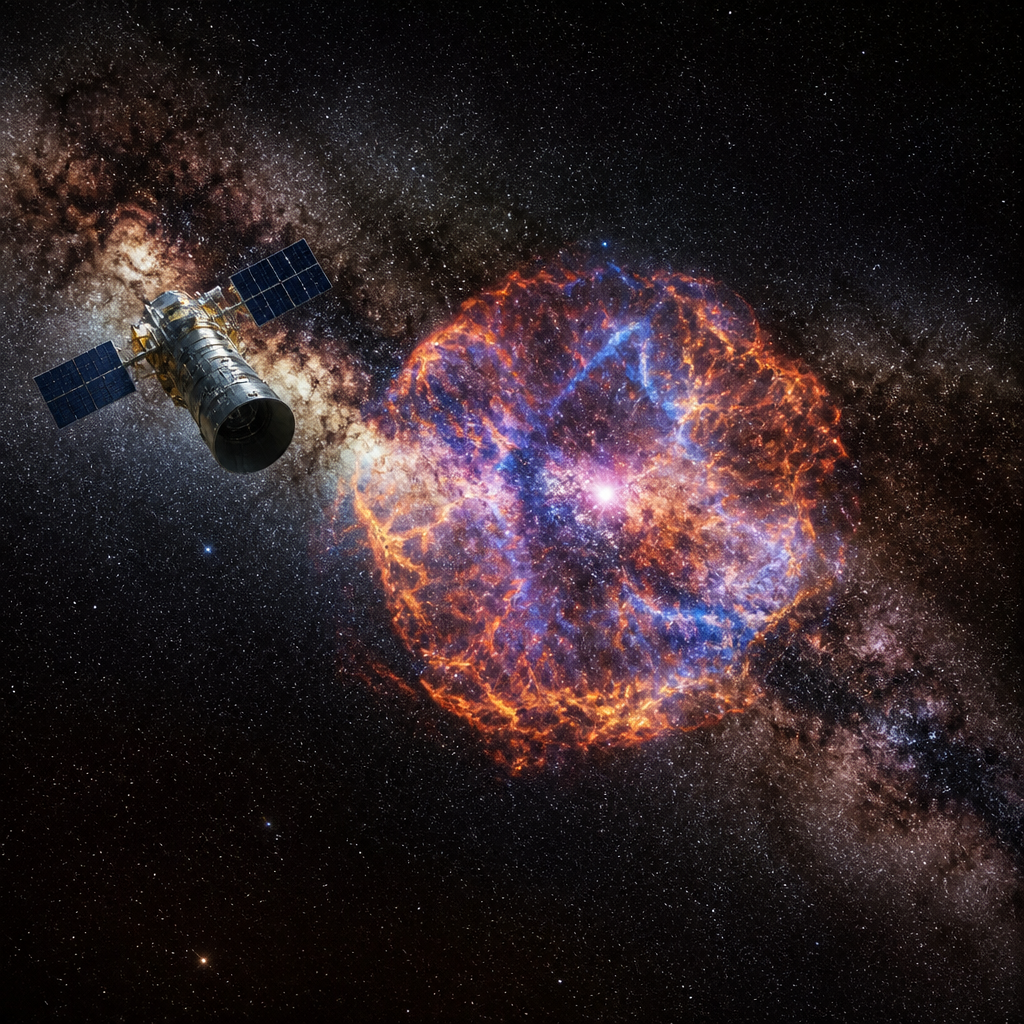
In groundbreaking celestial detective work, NASA’s Chandra X-ray Observatory has pieced together clues from the past and discovered the wreckage of a supernova, the cataclysmic death of a star, at the heart of our Milky Way galaxy.
Approximately 1,700 years ago, a star dramatically ended its life in a supernova explosion, an event so powerful it can outshine entire galaxies. This star didn’t go quietly into the night; it ejected debris at a staggering speed of 2 million miles per hour, scattering stellar shrapnel across the galaxy. Now, centuries later, Chandra, NASA’s X-ray “eye in the sky,” has detected the remnants of this celestial spectacle.
The Chandra X-ray Observatory, launched in 1999, has been instrumental in exploring the hot and energetic universe where X-ray emission is the key to understanding phenomena. With its X-ray vision, Chandra can see sources 100 times fainter than any previous X-ray telescope. This makes it the perfect tool for uncovering secrets of the universe, such as the supernova remnant discovered recently.
A supernova is a powerful and luminous stellar explosion, marking the end of a star’s life cycle. This explosion releases tremendous amounts of energy and debris, lighting up the cosmos and providing elements necessary for the formation of new stars, planets, and even life. The debris ejected from a supernova can travel at incredibly high speeds, racing out into the cosmos.
In this case, the remnants of the supernova have been hurtling through space for about 1,700 years, a blink of the eye in cosmic terms. The discovery of this astronomical artifact provides astronomers with a unique and valuable opportunity to study the aftermath of a supernova up close.
The heart of the Milky Way, where this supernova remnant was found, is a bustling region with a supermassive black hole and a high density of stars. It is heavily obscured by interstellar dust, making it a challenging area for optical telescopes to explore. However, Chandra’s X-ray vision can penetrate this dust, providing clear views of the region’s energetic events.
The discovery of the supernova remnants not only highlights the capabilities of the Chandra X-ray Observatory but also underscores the dynamic and violent history of our galaxy. Each supernova event contributes to the evolution of the Milky Way, spreading elements across space that will eventually coalesce into new stars and planets, maybe even fostering life.
This is a vivid reminder that the universe is not a static place. It is continually evolving and changing, with stars being born and dying in spectacular fashion. And thanks to the eyes of observatories like Chandra, we get to witness these cosmic events and unravel the mysteries of the universe, one supernova at a time.
Read more from the original source here: [https://www.space.com/astronomy/stars/nasa-x-ray-spacecraft-discovers-supernova-wreckage-at-the-heart-of-the-milky-way](https://www.space.com/astronomy/stars/nasa-x-ray-spacecraft-discovers-supernova-wreckage-at-the-heart-of-the-milky-way).