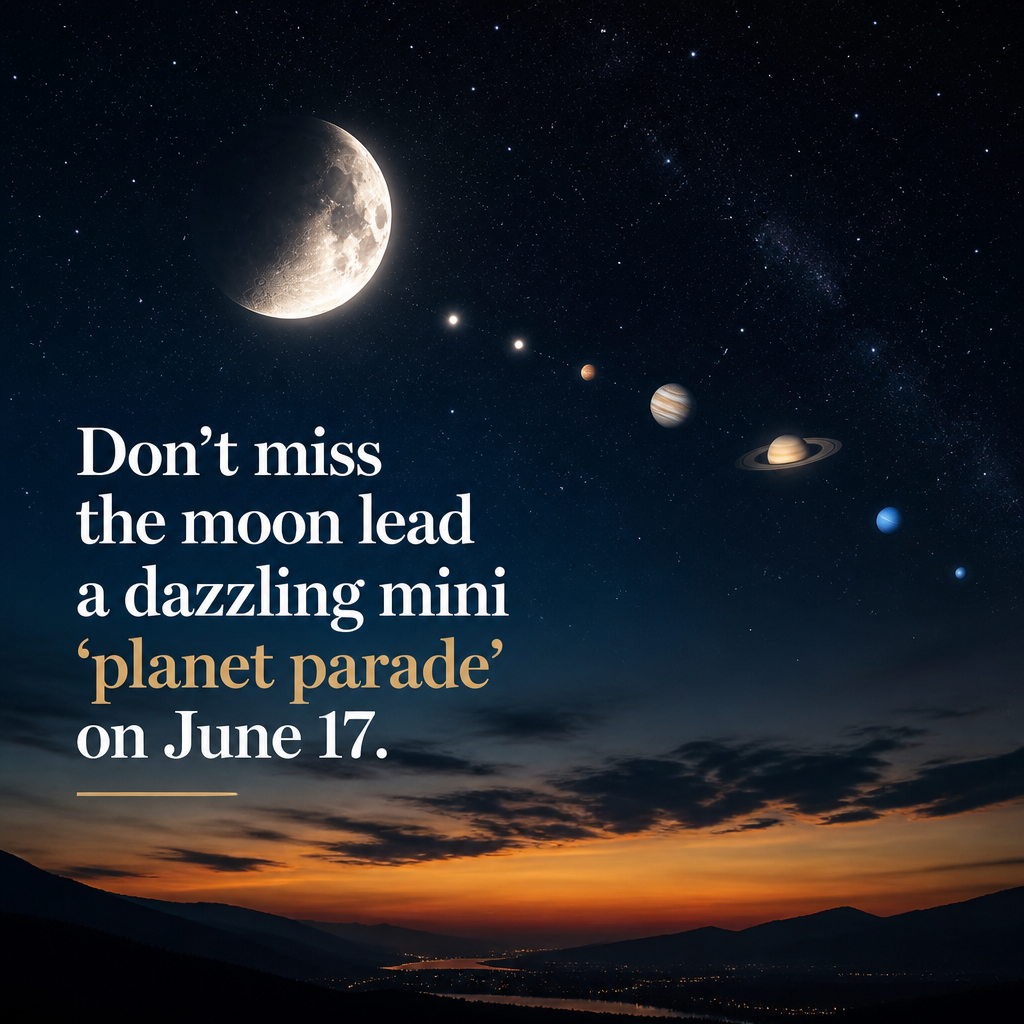
The crescent moon will take center stage on June 17, leading a stunning celestial spectacle where it will shine alongside three of our solar system’s most brilliant planets: Jupiter, Venus, and Mercury. This mini ‘planet parade’ will occur as the moon passes through the Beehive open star cluster, an event that promises a dazzling display for stargazers.
Located in the constellation Cancer, the Beehive Cluster, also known as Praesepe or Messier 44, is one of the nearest open clusters to Earth. Its stars are loosely grouped and appear to the naked eye as a small, faint cloud. But on June 17, the crescent moon will move through this cluster, offering a unique and dramatic backdrop for its encounter with Jupiter, Venus, and Mercury.
As the moon makes its journey, it will first appear near the planet Venus in the early evening sky. Venus, often referred to as the ‘Evening Star,’ is the third brightest natural object in Earth’s sky after the Sun and the Moon, making it easily visible.
Next, the moon will encounter Jupiter, the largest planet in our solar system. Jupiter is renowned for its brilliant glow, and even modest telescopes can reveal its four largest moons, known as the Galilean moons.
The final planet in the line-up is Mercury, the smallest and innermost planet in our solar system. Mercury, often elusive due to its proximity to the sun, will be visible in the twilight sky following sunset, completing the trio of planets accompanying the moon.
This mini ‘planet parade’ is a spectacle that can be appreciated by seasoned astronomers and novice stargazers alike. No special equipment is necessary to enjoy the show, although binoculars or a small telescope will enhance the experience, offering a closer look at the Beehive cluster and the planets.
The moon’s journey through the Beehive cluster and its rendezvous with Venus, Jupiter, and Mercury is a reminder of the dynamic and ever-changing nature of our night sky. It offers a valuable opportunity for us to look up, witness, and appreciate the cosmic ballet that unfolds above us.
To make the most of this celestial spectacle, find a location with a clear view of the western horizon and minimal light pollution. The event will commence at twilight on June 17, with the moon and the planets becoming visible as the sky darkens.
So, mark your calendars and prepare for a captivating astronomical display as the moon leads a dazzling mini ‘planet parade’ across the night sky.
Read more from the original source here: [https://www.space.com/stargazing/dont-miss-the-moon-lead-a-dazzling-mini-planet-parade-on-june-17](https://www.space.com/stargazing/dont-miss-the-moon-lead-a-dazzling-mini-planet-parade-on-june-17).